Showing posts with label jerusalem. Show all posts

Friday, July 24, 2009

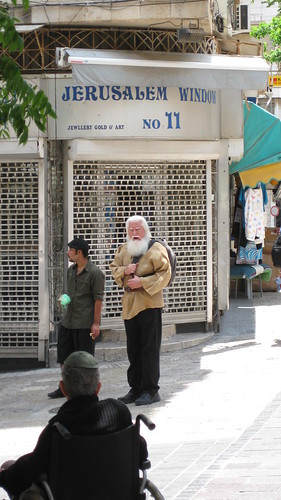
Scenes from the corner of Ben Yehudah & Ben Hillel, downtown Jerusalem


I can personally vouch for at least four years that this "prophet" has been in the Midreḥov (Ben Yehudah) because I used to watch him when I worked in a jewelry and judaica store there in 2005.

He has a sermon, as does any ordinary preacher. He preaches Jesus, as do thousands of street-corner and public-square preachers from the Bible belt. He wears some kind of tunic, which is a bit stranger ― but hey, he's sporting a backpack and trousers, which brings him back to this century. THE DIFFERENCE IS THAT HE SPEAKS FOR GOD IN THE FIRST PERSON, e.g. "I will send you a sign..." and "I sent my son Jesus, but you rejected him..."

I do not believe I have witnessed anyone else being the personal mouthpiece of the Almighty, to that degree. I saw a guy take him on verbally once, and he came back with "You WILL be destroyed!", repeated several times for rhetorical effect.

Other than that, the white eyebrows just make his presentation.

I've seen him in the company of others, having a non-prophetic conversation over a burger or whatever, and he seems to be sane. This is not Jerusalem syndrome.

Oh, and he prophecies in U.S. English. You won't find a precedent for that in the Old Testament.

(If anyone knows any more about this dude, please let me know. I'm morbidly curious as to how he makes a living, what he does in his off time, etc.)
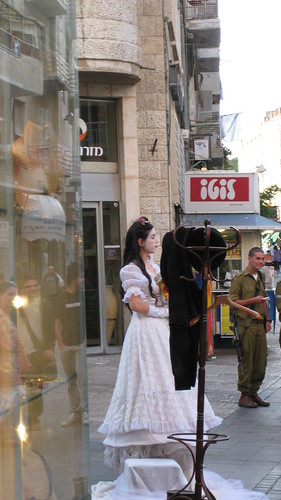


Same location, but this girl is in a different universe, genre-wise.

I've seen her act (from my job) three times, and still don't completely understand it. But she's basically a mime accompanied by music from the 30s, her sole prop being a coat rack that holds a coat and top hat. Every few moments she changes poses. And what her story is just eludes me, but she sure draws a crowd.
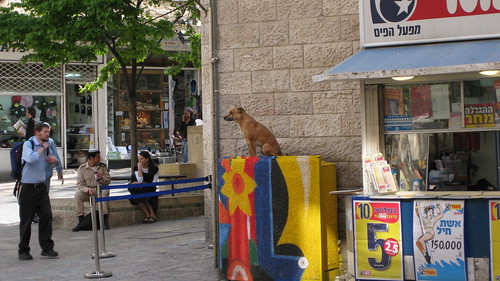


Opposite corner, same location.

I'm just picturing this dog asking people as they enter the Bank HaMizraḥi, "Yesh nesekh?" [Are you carrying a firearm?]

Bonus points for you if you've ever envisioned "Eshet Ḥayil" as a woman on the flying trapeze. (You have to click on the photo to see that part.)

Thursday, July 23, 2009

The Day Job I'm Not Quitting

Today I'm working in a factory. I'm making insulated water bottle carriers and backpacks. I get the canvas shell, already sewn together by someone else, inside-out. I pull the outside out, making sure the corners are in good shape, place the foam padding inside, thread the straps, and in the case of the backpacks crush them neatly to be stacked.

I wasn't hired to make backpacks, but I'm doing it, and you know what? I'm enjoying it.

Another part of my job: working in a store on Ben Hillel / Ben Yehuda (a.k.a. the Midereḥov), selling backpacks and other gear to shoppers of the pedestrian mall. That's not the job I applied for. In fact, it's not the job that was advertised.

Originally, I applied for a job in management in this company, coming right off of another management job that was outsourced to the Philippines. I also explained at length to the company owner that I could help him in some other ways, using some other skills and ideas I'd picked up in the previous months.

It turned out that I was not right for the management position he was trying to fill, but he liked my other ideas. And he need someone to work in the store, starting immediately. Could we make a synergy? Yes, we could. We did. And now I'm working, enjoying it, learning new skills, and pursuing the project that I recommended to him in the first place.

I also have more freedom than in my previous job to pursue some side projects that I've dearly been wanting to do ― the kind of projects for which you are advised, "Don't quit your day job".

The moral of this story is something like this. There is a tough job market right now, perhaps especially for Anglo Israelis with limited Hebrew. I'm guessing that it is always tough for ’olim who come with some professional training or experience in a field that may have been viable in the old country, but which is little more than useless here (let's just use “professor of French” as a random example). That can be pretty discouraging. I've spent too much time since my aliyah being unemployed, faced with the perplexing problem of job listings not lining up with my chosen career.

Thanks to a little bit more open mind, I've been a sous-chef for a gourmet kosher caterer, ridden around North New Zealand with milk tank truck drivers, and helped build a store on Ben Yehudah street, working side-by-side with Arabic-speaking construction workers. I'm not saying I'd want to carry on with these jobs in the long term, but I'm glad I did them. I don't care anymore when people ask me, "Is that why you spent six years in grad school?" Each one gave me some experiential knowledge that I carried into the next job.

What I'm experiencing right now is a providential kick in the pants. It's the opposite of the mentality (such as mine was) that says: "What did I major in? What experience do I have? Okay, now let's see what job listings correspond to that."


I began writing this posting during lunch, and went back to work after a couple of paragraphs. While finishing backpacks I started chatting with the foreman of the operation, who was using a jigsaw to cut bolts of canvas in order to make new backpacks. Mahmoud has 30 years of experience, 14 years in this company, and has the disposition of a artist in his workshop. Sensing an interest, he asked me if this was a skill I'd like to learn. "And then you can work here, and I can go off to the beach?"

Sure, he was joking, but as we kept chatting for the rest of the afternoon, I could see this wasn't a 100% pointless conversation. It could turn into something bigger. Or not. The important point for me was that this was not a job that was listed, and even if it were, I would have never have given it a second's thought. But I'm working.

Wednesday, July 22, 2009

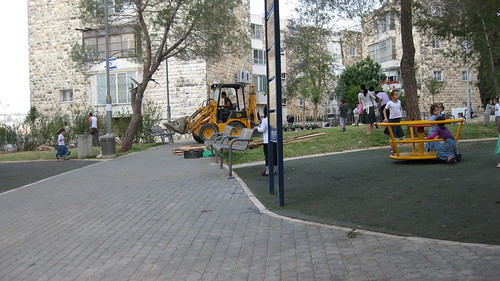
bizarro playground


On a normal weekday afternoon, some "city workers" are driving heavy machinery around in a neighbourhood playground where children are playing.

My first reaction was, "This would seem perfectly normal, if there were not already two terror attacks in the past year and a half involving 'city workers' going postal while driving heavy machinery in public places."

I mean, they plowed into buses, flipped cars over, etc. These were called terrorist attacks.

On the other hand, if we most accept our fellow human beings as being basically decent folk, maybe the normal thing to do is to let our children play in the same place that bulldozers are zipping around.

But then, the litigious American side of me shrieked, no way! This is crazy!

I could be wrong. What do you think?

We left right after I snapped a couple of pictures.


This sign says that if you see someone cloaked in a black fedora and trenchcoat, he's a spy, and is not allowed in the playground. Alternatively, he's a cast member of of the "Drama in the Park" summer series.

Under that: if you bring your gigantic dog into the park and he jumps on children as they shriek in horror, and you insult them by shouting, "Why are you afraid? Poopie can't possibly hurt anyone", residents have the right to make Poopie ownerless.

Take a look at this URL. (A website for a playground: isn't that cool? We're one step closer to getting everything interconnected! Before you know it, your children will have a chip in their head, and you can just watch them play on Google Earth 4D.)


Now compare it with this alternative URL.


Which is apparently for the version of the site run by Al-Aqsa.

Sunday, July 19, 2009

When not to give tsedakah

Gil Student on Hirhurim recently had this post about giving tsedakah (~charity) to somebody who could otherwise be working.

I'm proud, first of all, to be part of a religion that doesn't just yell, "Get a job!" but first asks a question and examines the subject.

It reminds me of an ongoing problem I have determining which street beggars to give money to.

My understanding of the subject, dating back to 10 years or more, is that on Purim we are required to give to anyone who puts out their hand (or alternatively, we fulfill our responsibility to give charity on that day by giving to the first one who asks for it, and by giving them at least enough to get a meal), without checking out whether they are a worthy recipient. From here we see that during the rest of the year, not on Purim, we are required to check out whether the person is a worthy recipient.

I could be wrong, and welcome correction if I am.

Since coming to Israel I've had to make thousands of judgment calls about collectors ranging from street beggars to synagogue visitors to proven legit organisations such as Yad l'Aḥim. While working on my own personal trait of generosity vs. selfishness, I've tended to give more to the latter than to the former.

There may be something to the basic gut belief that a miserable creature on the street deserves some change, by virtue of the fact that they are spending their day on the street begging. May be. I have become familiar with a good dozen or so of them here in the city, and I'm not saying their daily life is enjoyable.

But one must admit that, in Jerusalem especially, street tsedakah can be lucrative business. I've heard enough trustworthy accounts of collectors driving luxury cars and living in swank apartments with large-screen home theatres. And I've been in non-charity business long enough to know that human nature will find a way to channel a proven cash flow, no matter how "noble" or "charitable" the religious act of giving tsedakah may seem to be from the outside.

For example, let's say bar minan that a guy can't afford to pay the medical bills for his child's surgery, so he takes to the street. Let's give the story a happy outcome and say that he collects the needed amount. The child heals, and grows up to be stronger and healthier than ever. Meantime, the father has discovered that he makes 5 times as much by collecting tsedakah than he'd made in any job before. He's pulling in more daily than a Persian shop owner in Geulah makes in profit weekly. And he's gotten past the initial feelings of shame and self-pity that may have plagued him at the beginning of his begging.

You tell me: why would he ever quit?

Give to whomever you want; I'm not telling anyone to do anything. But six years of street experience in the capital of Israel has led me to formulate the following informal list, for what it's worth.

I will not give tsedakah to:
  • Anyone collecting on Ben Yehuda or adjoining streets (i.e. the Midereḥov) or on the steps leading to the Kotel

  • Anyone offering a red thread

  • Anyone who bullies me (blocks my path, yells at me threateningly, etc.)

  • Anyone who appears to be under 40 and in great health, with no further explanation

  • Anyone who is chain smoking

  • Attractive young women wearing peot (i.e. sheitels), jean skirts, and Gucci bags (even knock-off Gucci bags) (Okay, I may be exaggerating about this profile, since I've only seen it once, and it fits in the third criterion above.)

  • Anyone dressed as a ḥaredi whom I've observed "off the job" and found to be a fake.


Finally, if you do decide to give tsedakah to the first person who appears worthy, make sure he's actually collecting tsedakah. I know a woman who travelled from B'nei Beraq to the Kotel plaza with the intention of giving tsedakah to the first person whom she saw begging. Spotting an old man sitting on a bench with his cup extended, she dropped her money in. Only then did she discover that she had just ruined his cup of coffee.

For the record, I highly recommend Yad l'Aḥim: here in English and here in Hebrew.
 
Creative Commons License
This Israeli Life by Michael Eliyahou is licensed under a Creative Commons Attribution-Non-Commercial-Share Alike 3.0 Unported License.