Showing posts with label midereḥov. Show all posts

Tuesday, August 11, 2009

Working in the midereḥov

I work in a retail store in the downtown pedestrian mall (the "midereḥov") of Jerusalem. That's the other side of the day job I'm not quitting. This is the second time I've worked in a store in the midereḥov since moving to Israel 6 years ago, so I am fairly familiar with the scene.

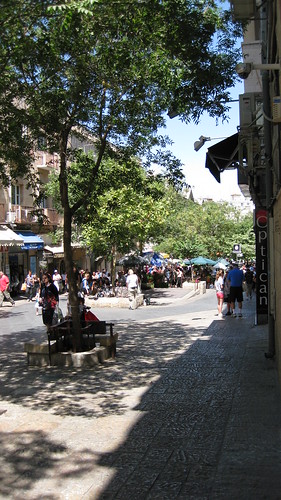
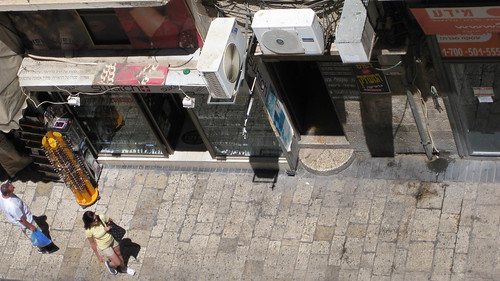
If you don't know what that is: well, first of all, it's not a mall. It's a couple of wide, stone-paved streets that are mostly blocked off to traffic and lined on both sides with storefronts, banks, and entrances to the apartments and offices that rise above the commercial landscape. There are islands in the middle of the street that provide a little greenery and a little seating here and there. It's a popular site for street festivals or throngs of Saturday night shoppers who prefer the outdoors to a "real" mall, grabbing the last few moments of the weekend before Sunday morning and the business week sets in. That's where the photos in this entry came from, plus these here.

I am guessing that the traffic is about half tourists, half Israelis. More tourists in the summer, of course. This means that I get to deal with a variety of nationalities and a variety of mentalities on a daily basis. There are also street performers all the time, and since I work near a major intersection I get to hear their entire repertoire, repeatedly. There is nearly never a dull moment.

Different people have different impressions of Ben Yehudah. I think for a lot of foreigners, even those who live here long-term, this is like the most glamourous spot in the city, a romantic hub of excitement and energy.
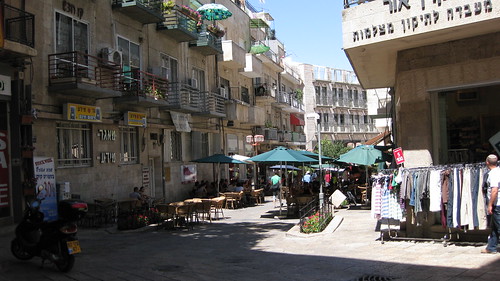


I don't experience the midereḥov like that. For me it has always been about business and efficiency, making every moment count because the clock is ticking. This is not unpleasant, but it puts me in a frame of mind that few of the street passengers I see are sharing.

I have no background in commerce and no formal business education, but "on the street" experience in the last decade has changed that. I used to be an academic, spent as much time on campus as possible, and never learned the rules of the "shuk", as it's called here, until I was in the middle of it.

Besides being a salesman in a store and dealing with a variety of customers, I've also managed a virtual office, that me and my fellow project employees built from scratch. It started out as an Israeli team, and eventually spanned four continents. This was completely different from the experience I'm getting now in manufacturing and retail, and it is great to see a variety of businesses, from all different angles.


And I have a dilemma. Especially given the elephantine memory of the internet, I don't know how much detail to go into regarding my personal interaction with customers and other people off the street.

I really want to. I want to tell you about the customer who verbally abused me for 15 minutes this morning, including banging on the glass to insist that she get her way. And I want to tell you how one particular nationality of people (a nation that I used to want to be a citizen of, obsessively trying to make myself one of them) is collectively driving me crazy, to the point that I dread hearing their accent when they walk in the store.

What do you think?
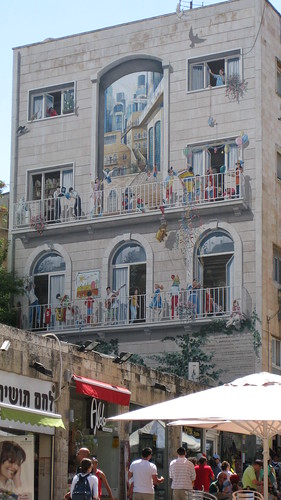


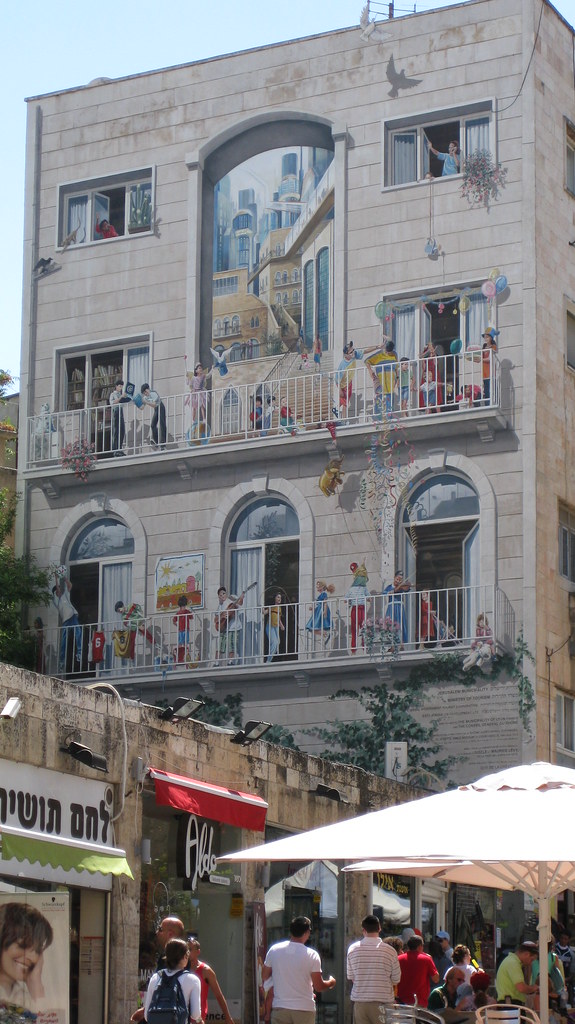
Changing the subject (ahem), this building has been decorated by an art form called "Trompe-l'œil" (optical illusion) that is particular to Lyon, France. Apparently the same artists were hired for these Jerusalem buildings, too. There are a few of them around town here, and I will try to get some good shots of them another time. But for now, the best I have to offer is the higher-resolution image you can see by opening this link.

Friday, July 24, 2009

Scenes from the corner of Ben Yehudah & Ben Hillel, downtown Jerusalem


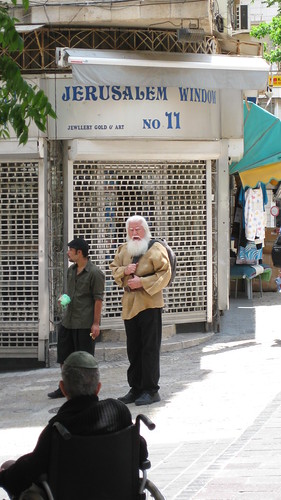
I can personally vouch for at least four years that this "prophet" has been in the Midreḥov (Ben Yehudah) because I used to watch him when I worked in a jewelry and judaica store there in 2005.

He has a sermon, as does any ordinary preacher. He preaches Jesus, as do thousands of street-corner and public-square preachers from the Bible belt. He wears some kind of tunic, which is a bit stranger ― but hey, he's sporting a backpack and trousers, which brings him back to this century. THE DIFFERENCE IS THAT HE SPEAKS FOR GOD IN THE FIRST PERSON, e.g. "I will send you a sign..." and "I sent my son Jesus, but you rejected him..."

I do not believe I have witnessed anyone else being the personal mouthpiece of the Almighty, to that degree. I saw a guy take him on verbally once, and he came back with "You WILL be destroyed!", repeated several times for rhetorical effect.

Other than that, the white eyebrows just make his presentation.

I've seen him in the company of others, having a non-prophetic conversation over a burger or whatever, and he seems to be sane. This is not Jerusalem syndrome.

Oh, and he prophecies in U.S. English. You won't find a precedent for that in the Old Testament.

(If anyone knows any more about this dude, please let me know. I'm morbidly curious as to how he makes a living, what he does in his off time, etc.)


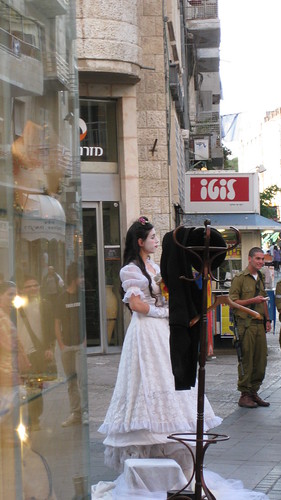
Same location, but this girl is in a different universe, genre-wise.

I've seen her act (from my job) three times, and still don't completely understand it. But she's basically a mime accompanied by music from the 30s, her sole prop being a coat rack that holds a coat and top hat. Every few moments she changes poses. And what her story is just eludes me, but she sure draws a crowd.


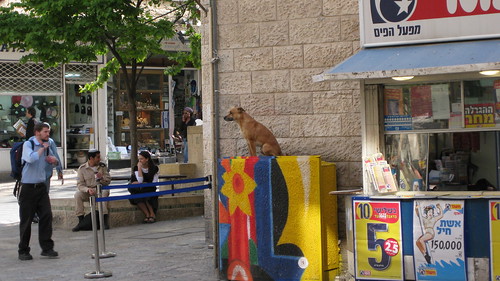
Opposite corner, same location.

I'm just picturing this dog asking people as they enter the Bank HaMizraḥi, "Yesh nesekh?" [Are you carrying a firearm?]

Bonus points for you if you've ever envisioned "Eshet Ḥayil" as a woman on the flying trapeze. (You have to click on the photo to see that part.)

Sunday, July 19, 2009

When not to give tsedakah

Gil Student on Hirhurim recently had this post about giving tsedakah (~charity) to somebody who could otherwise be working.

I'm proud, first of all, to be part of a religion that doesn't just yell, "Get a job!" but first asks a question and examines the subject.

It reminds me of an ongoing problem I have determining which street beggars to give money to.

My understanding of the subject, dating back to 10 years or more, is that on Purim we are required to give to anyone who puts out their hand (or alternatively, we fulfill our responsibility to give charity on that day by giving to the first one who asks for it, and by giving them at least enough to get a meal), without checking out whether they are a worthy recipient. From here we see that during the rest of the year, not on Purim, we are required to check out whether the person is a worthy recipient.

I could be wrong, and welcome correction if I am.

Since coming to Israel I've had to make thousands of judgment calls about collectors ranging from street beggars to synagogue visitors to proven legit organisations such as Yad l'Aḥim. While working on my own personal trait of generosity vs. selfishness, I've tended to give more to the latter than to the former.

There may be something to the basic gut belief that a miserable creature on the street deserves some change, by virtue of the fact that they are spending their day on the street begging. May be. I have become familiar with a good dozen or so of them here in the city, and I'm not saying their daily life is enjoyable.

But one must admit that, in Jerusalem especially, street tsedakah can be lucrative business. I've heard enough trustworthy accounts of collectors driving luxury cars and living in swank apartments with large-screen home theatres. And I've been in non-charity business long enough to know that human nature will find a way to channel a proven cash flow, no matter how "noble" or "charitable" the religious act of giving tsedakah may seem to be from the outside.

For example, let's say bar minan that a guy can't afford to pay the medical bills for his child's surgery, so he takes to the street. Let's give the story a happy outcome and say that he collects the needed amount. The child heals, and grows up to be stronger and healthier than ever. Meantime, the father has discovered that he makes 5 times as much by collecting tsedakah than he'd made in any job before. He's pulling in more daily than a Persian shop owner in Geulah makes in profit weekly. And he's gotten past the initial feelings of shame and self-pity that may have plagued him at the beginning of his begging.

You tell me: why would he ever quit?

Give to whomever you want; I'm not telling anyone to do anything. But six years of street experience in the capital of Israel has led me to formulate the following informal list, for what it's worth.

I will not give tsedakah to:
  • Anyone collecting on Ben Yehuda or adjoining streets (i.e. the Midereḥov) or on the steps leading to the Kotel

  • Anyone offering a red thread

  • Anyone who bullies me (blocks my path, yells at me threateningly, etc.)

  • Anyone who appears to be under 40 and in great health, with no further explanation

  • Anyone who is chain smoking

  • Attractive young women wearing peot (i.e. sheitels), jean skirts, and Gucci bags (even knock-off Gucci bags) (Okay, I may be exaggerating about this profile, since I've only seen it once, and it fits in the third criterion above.)

  • Anyone dressed as a ḥaredi whom I've observed "off the job" and found to be a fake.


Finally, if you do decide to give tsedakah to the first person who appears worthy, make sure he's actually collecting tsedakah. I know a woman who travelled from B'nei Beraq to the Kotel plaza with the intention of giving tsedakah to the first person whom she saw begging. Spotting an old man sitting on a bench with his cup extended, she dropped her money in. Only then did she discover that she had just ruined his cup of coffee.

For the record, I highly recommend Yad l'Aḥim: here in English and here in Hebrew.
 
Creative Commons License
This Israeli Life by Michael Eliyahou is licensed under a Creative Commons Attribution-Non-Commercial-Share Alike 3.0 Unported License.